Kawasaki

Best auto news from around the world.

This is default featured slide 2 title

Go to Blogger edit html and find these sentences.Now replace these sentences with your own descriptions.

Bajaj Kicks back again

Bajaj Launches the all-new Pulsar 200NS.

This is default featured slide 5 title

Go to Blogger edit html and find these sentences.Now replace these sentences with your own descriptions.

Wednesday, March 21, 2007

Pulsar 220 vs Karizma Drag Report and Pics


First lets start with Pulsar 220 review:-


Overview


The bike looks good & it’s stunning. It feels big when you sit on it, infact it gives you a big Bike feel the moment you sit on it, mainly due to the clip-ons & slightly backwards footrests. BAL as again has got a winner here, the fit & finish levels are very good infact much better than HH or for that matter ZMA. The digi Speedo console looks great & the self test looks charming. The first things that you notice are missing choke lever, fuel knob & a new pass beam switch along with the backlit switch panel & of course the LCD Digi console.

The Riding experience

My biggest worry was since this bike doesn’t have kick starter was how good the self starter would be & am glad to say that the self lived up to its expectation. The Bike starts very smoothly & almost effortlessly.
The gear shift is smooth & precise but still doesn’t not slot like karizma, some like it some don’t. I was fine with it as I had used this type of shift on my pulsar 180 but yes this one was better than the one on mine. Not a leap of change in the gear shift but nevertheless a good one. Those who like slotting gears may still crib but I was happy with it as I had no false neutrals & no wrong gears.
The engine is smooth really smooth & the Bike picks up really sweetly, the exhaust note is nice but whether one likes it or not may differ from person to person. Once revved up the Bike gets the typical pulsar vibes near tank & fairing though they are minimal but can still be felt on the knee touching the fairing near tank. These vibrations come around 70kph & above.
Just like its smaller siblings the RVMs on P220 become useless at these speeds as they vibrate so much that you cant make out what you see in the mirrors but since you cant see much anyways its not much of a problem. Oh that reminds me did I tell you guys that the RVMs are absolutely useless especially if you are wearing a minimalist riding gear, reminds me of classic Pulsars which had stylish mirrors but very poor visibility wrt the ones sported by DTSI versions, Yeah BAL did it again.

The Bike picks up really well on roll-ons, the most amazing thing was that even at 5th gear the Bike picked up at 25kph, though it pinked a bit but still picked up without any jerks .


Riding Comfort

I found the suspension to be a little stiffer than Karizma while Pawan(owner of 220) felt otherwise. The roads had no bad patches so cant say about how they would feel under bad road conditions.

The bike has very sporty feel to it. The seats have good support & it holds you well. The Bike is really good if you want to ride it fast (which of course you would). I rode the P220 for around 10-15 kms & my right shoulder started to pain, does it make it really bad for long riding ?? To answer this, it reminds of the first two days when I had bought my 180 DTSi (which was my first Bike ever) & when my arms pained like hell for two complete days  so it’s just a matter of getting used to. So does this make the Pulsar 220 a good tourer ?? Or to say will it be more comfy than a karizma for long rides ?? In my humble opinion with a guy of my height (am 5’10”)NO. Although the engine is really refined with enough power to take long stretches effortlessly the riding posture is not what you would want for such long rides. Having said that it’s still a matter of personal choice, I mean some of my friends keep doing long rides on SBKs which in common perception are not good for long rides.
Disclaimer: I am not comparing it to the SBKs, just the riding posture.

All those who got disappointed here’s another way to look at it. Those who are shorter in height may find the Bike to be better than the karizma for riding comfort since they wont face the issue which taller guys like me faced i.e. crouched position & knees touching the fairing. So I think it can be safely put that it would be more comfy for shorter people that taller people for long rides

Handling

I took the P220 on ghats & on straights; the Bike has really good handling when compared to the smaller pulsars especially because of the better swing arm & the riding posture & not to forget wider tubeless tires. The Bike is very eager to lean when compared to previous Pulsars. So is this the new Handling champion ?? Sadly No here where I hated BAL the most, they have actually ruined a great handling Bike into a non handling one, the reason ?? The stupid main stand aargh the mains stand scrapes at slightest of the lean  I am very sure infact confidant that if the main stand is removed the Bike will be an awesome handler

Ok just before some shouts that some have taken curves without scraping the stand, I will like to make it clear that the stand scraping happens when you are taking tight twisties uphill or downhill i.e. it won’t affect much on straights but then you only need the leaning aspect on such twisties

Braking

Full marks here no comments it simply rules here Excellent breaking supported by a wide profile rear as well as front tire(Yes the front tire is broader too )

Headlights

10 out of 10 or may be 11 out of 10. The lights everywhere including the headlights are superb. Let it be tail lamps or the LCD or the backlit switches.

Drag Results

Frankly speaking the drags which we had were very amateurish & should be taken only as indicative & not as a proof because:

- The bikes had diff mileage on odo
- The drag was done on a strip which was barely 100-200 mtrs
- We had no timing device. And a few launches were not synchronized properly
- My Yellow Karizma is stock but has heavier & broader rear tire.
- The Pulsar 220 owner is not a good dragger.

Result 1: P220 VS Stock ZMA

P220 won on 2 runs

Result 2: P220 vs. Modded Karizma (with K&N and bigger jets)

Pulsar 220 won once and Karizma won 3 Times


Conclusion


Well am no journalist & this isn’t any magazine so I am really not sure what to post as a conclusion or verdict, rather I would put it as answers to commonly asked Qs

Q1: Is the P220 worth buying its price?
A1: Hell yeah! the P220 is a very good piece of machinery.

Q2: Is it better than ZMA?
A2: This is still debatable, while the engine is more powerful & has more torque than the ZMA, it still has niggling issues like poor RVMs & vibrations at higher revs which the Karizma lacks, Also the handling though very good is marred by the stupid stand which I believe can be fixed.
At the end one has to decide his priorities & go for it

Q3: Should I trade my karizma for the P220
A3: Unless you want to go for all the gadgetry & that extra power NO. Remember the slightly mudded zap beat it in the unofficial drag.

Phew that was one long write up. Now Enjoy the pics:-

All the bikes Lined up


Pulsar 220 and Stock karizma:-


Modified karizma with K&N filter and bigger jets:-


Black Pulsar 220 :-


Drag Pics:-


VIDEOS COMING SOON


Credits:-
Pictures and Write-up By technocrat (www.xbhp.com)
Pulsar 220 Is of Pawan Pullwar
Yellow Karizma is of technocrat
Black Modified Karizma is of Vivek

Source:- www.xbhp.com

Sunday, March 18, 2007

TVS launches special riding gear for Apache owners

Indias third largest bike manufacturer TVS Motor has launched special riding gear for Apache owners. the riding gear includes Helmets (Brand: Vega) which are stylish with affordable price tags(Rs. 1117). 4 colors available.
They also have Gloves which are quite cheap too(Rs. 447) 2 colors available with M and L size.
Tees are just "must have" for a Apache owner. nice print and colors . Price range starting from Rs 256.
They also have Dedicated Apache Tank Pads (Rs.183), Apache tank bags (Rs. 245), AutoCop security system for Apache(Rs. 1531) ,seat Covers for Apache (Rs 296)and Bike covers(Rs. 312). U can purchase all these from any TVS dealer. For more info log on to:-

http://nowornever.in/AccessoriesHome.aspx

Tuesday, March 13, 2007

TVS Star Sports Launched


Two-wheeler major, TVS Motor Company (TVS-M) has launched a sport variant of its popular entry level motorcycle, 'Star City'. Launched in two versions, the basic and premium, the 100 cc 'Star Sport' is expected to strengthen TVS-M's market share in the entry level segment.

Further, the year 2007-08 will be an year of new launches and new initiatives for the company. Besides a slew of new launches, TVS-M's two new plants at Himachal Pradesh and Indonesia are also set to go on stream next fiscal.

"We have come out with 'Star Sport' to cater to that segment of customers, who were looking for more style in Star. While the Star variants at present have a market share of 10%, among all categories put together, we expect this to increase to 13%, with the launch of 'Star Sport," Mr K N Radhakrishnan, president, TVS-M told a press conference here on Monday.

Within the 'entry-level' segment, the Star variants command a 26% market share. "We hope to get market leadership in the entry level segment, with the launch of 'Star Sport' and we expect the market share to increase to 35%, from the present 26%," Mr Radhakrishnan said.

He agreed that the launch of yet another variant of Star, may result in eating into the sales of some of the other models from the company. "There could be cannibalisation to the tune of around 10%. But, then the move launch a more stylish Star is for a set of customers, who were keen to buy a Star if it offered more style, alongwith its existing qualities," he said.

While the basic variant of 'Star Sport' has been priced at Rs 33,990 (ex-showroom Chennai), the premium variant of the new model will carry a price tag of Rs 35,490 (ex-showroom Chennai). Nearly 75% of TVS-M's motorcycle sales comes from the Star variants, with another 15% - 20% coming from Apache and the Victor series contributing the rest.

According to him, the financial year 2007-08 will be an year for new launches and new initiatives. "Our plant in Himachal Pradesh will go operational in April this year, even while the company's first overseas plant in Indonesia, is expected to do the same in May. We will also be launching a new Apache, a three-wheeler in August, and a new Victor during 2007-08," Mr Radhakrishnan said.

The move to launch a new Victor, re-inforces the fact that the company needs an aggressive model in the segment to influence market share. "Nearly 50% of all the two-wheelers sold are from the executive segment, where we have just about 5%-7% share. The new product will help us increase our numbers significantly in this segment," he said.

Source:- EconomicTimes

Sunday, March 11, 2007

Govt links Harley's entry to bank licences in US

ICICI Bank chief KV Kamath and State Bank of India chairman OP Bhatt's plans to expand their footprint in the United States could be linked to Harley Davidson's entry into India.

The US government seems more than keen to ensure that India lowers import duty for Harley Davidson besides allowing it to ply on Indian roads despite not complying with the Euro emission norms.

Sources negotiating with US said deep interest is due to Harley Davidson's association with US President George W Bush.

While India has made it clear that it was not in a position to allow Harley Davidson's import without complying with the Euro II emission norms, it has indicated its willingness to follow a system of tariff rate quotas (TRQs) that will mean lower customs duty for a certain number of bikes (say 1,000), beyond which the applicable customs duty will be levied.

Sources said US government officials, who again raised the issue with their Indian counterparts earlier this month, have indicated that Harley Davidson expects to sell around 10,000 bikes over the next 10 years.

By allowing for TRQs for Harley Davidson, the government may be getting into a knotty situation and will make it open to such demands from other automobile makers, who have been complaining of the high import duties in India in the "garb" of protecting domestic manufacturers. So far, India has confined the use of TRQs largely to FTAs when dealing with import of sensitive products.

But officials said India will give the method a try if the US government was willing to grant fresh branch licences to ICICI Bank, SBI and Bank of Baroda, whose proposals have been pending for several years and also fast-track new rules for export of Indian mangoes.

"Indian negotiators have made it clear that any progress on Harley Davidson's case has to be linked to the progress on banking licences. Since US is more than keen to get a favourable dispensation for the bike maker, India is simply trying to seize the chance to negotiate a better deal for its banks,"said a negotiator.

The US government has kept in abeyance applications from the three Indian banks saying that India needs to amend its Prevention of Money Laundering Act to provide that terrorism per se is an offence.

It has said that amendments were a pre-requisite for India to become a member of the elite Financial Action Task Force (FATF).

But India, which believes that US is trying to arm twist it into agreeing on the changes, has cited China's case and said that membership of the FATF was a political decision.

China, which hardly follows any of the prudential or money laundering norms, was recently accorded observer status in the FATF.

In a retaliatory move, the government wants RBI to stop issuing fresh branch licences to US banks. But with Harley Davidson betting big on India, Indian banks could just get a few more US branches.

Source:- timesofindia.indiatimes.com

Saturday, March 10, 2007

Tata's car affect on market: Bajaj

There's no doubt Ratan Tata had only good intentions when he said he conceived the Rs one lakh car as he cared for the safety of those using two-wheelers. But Bajaj Auto Chairman Rahul Bajaj thinks its just a ploy to market the vehicle.

"He has to sell his car... so he has to speak like that," Bajaj shot back when reporters asked him about Tata Group Chairman Ratan Tata's remark that one of the major reasons for him to decide on the 'people's car' was the concern for safety of those travelling by two-wheelers.

Two-wheelers are sold all over the world, it has been proven that they are safe, he said, adding his company's products were safe.

Bajaj also denied that the advent of Rs one lakh car would affect the two-wheeler manufacturers.

"Ultimately it is the customers who will decide what they want," he said.

Tata had said that the Rs one lakh car would mark a paradigm shift in the way India travels and will draw customers from the two-wheeler segment as well as from the lower end of the four wheeler segment.

The small car to be powered by a 600 cc engine, which could have air conditioning option and seat four to five people, is widely considered to be a threat to the two-wheeler segment.

Tata Motors is in the process of building a plant in Singur in West Bengal for the people's car, which it hopes to roll out by next year.

The price differentials between the small car and the high end motorcycles likes of Bajaj Pulsar 200 cc, the to-be-launched Pulsar 220 cc and Hero Honda Karizma are expected to be minimal.

No division of Bajaj Auto : Rahul Bajaj

Ruling out a complete division of the Bajaj Auto empire between his two sons, Rajiv and Sanjiv, Chairman Rahul Bajaj Friday said they would continue to be part of the company even after the proposed demerger takes place.

"Both the boys will clearly continue to be in Bajaj Auto, no doubt about it," Bajaj told reporters here.

He, however, added that his younger son Sanjiv "may probably spend more time on the new demerged company or companies".

Bajaj reiterated that plan to demerge the company's financial and investments business into a separate entity was based on the intention of unlocking shareholder value by utilising surplus cash and not because of the reported "rift between the brothers".

"You cannot simply divide a company between individuals when you have so many shareholders interest to be taken into consideration," he said.

The board of Bajaj Auto is likely to take up the issue of demerger in its meeting in May or July, he added.

Sanjiv, Executive Director of BAL, however, said the demerger process was being evaluated at the moment and it would depend on what kind of impact it would have on bal.

"If the cash flows of BAL continue to be positive after the demerger, probably the board will give a go ahead. But if it is going to be negative, I don't think the board will approve of it," he said.

Sanjiv, however, added that in the past few years the company's cash flows have been positive and is likely to continue so.

Asked if the proposed demerger of Bajaj Auto would have any bearing on the company's joint-ventures with German financial firm Allianz, Rahul Bajaj replied in the negative.

"It will have no effect whatsoever on the shareholding of the joint ventures with Allianz," he said.

Bajaj Auto has joint ventures with Allianz -- Bajaj Allianz Life Insurance and Bajaj Allianz General Insurance -- in which it is the majority partner.

On the issue of BAL's 41.5 per cent holding in Bajaj Auto Finance post demerger, he said the board would decide on how and where it would be transferred.

Bajaj also said even if the board gives its nod for the demerger, the whole process was likely to take time as it would have to get regulatory and high court approvals.

BAL has about Rs 8,000 crore cash surplus and its foreign institutional investment partners have been pressing it to utilise it by hiving off the financial and investments business into separate entity.

Source:- CentralChronicle

Stoner storms to maiden win


Casey Stoner held off 22 laps of intense pressure from Valentino Rossi to take his first Moto GP win at the Qatar Grand Prix.

The 21-year-old Australian made the most of his Ducati's superior straightline speed to hold off the Italian on what was his first race for the Italian squad, triumphing by 2.838 seconds and taking a five-point lead in the championship.

Pole-man Rossi held the lead at the start, followed by Stoner and Toni Elias, but Stoner blasted by the five-time world champion as they crossed the line for the first time, giving notice of his intent to fight for victory.

Rossi's Yamaha was equal to Stoner's Ducati through the twisty section of the track, and it was there where he passed the Australian three times during the race, but was each time undone by his bike's lack of straightline speed, which was 20kph slower than his rival's.

In the end, Stoner made the decisive move on lap 19 when he powered into the lead on the approach to the first corner and then set the fastest lap of the race on the final tour to take victory.

Third was the Repsol Honda of Dani Pedrosa, who made the best of an ill-handling bike to hold off the Suzuki of John Hopkins – who was riding with his hand in bandages following a testing crash.

The pair spent the first half of the race right on the tail of Stoner and Rossi, in what was a six-bike fight for the lead with Loris Capirossi's Ducati and Marco Melandri's Gresini Honda. That battle became five-way when Capirossi binned it on lap seven.

Melandri went backwards through the first half of the race after a bright start, but recovered as his fuel load lessened to pass the Yamaha of the disappointing Colin Edwards for fifth with three laps to go.

Seventh was Chris Vermeulen on the second Suzuki, while world champion Nicky Hayden took a battling eighth on his Repsol Honda – passing Alex Barros' d'Antin Ducati with two laps to go. Shinya Nakano completed the top ten on his Konica Minolta Honda.

It was a disastrous race for Elias though, who was lay third at the first corner. After falling back through the field all afternoon, he took a trip through the gravel after being passed for ninth by Hayden and eventually finished 14th.

At least he finished though, which was more than could be said for Kawasaki's Randy de Puniet, who high-sided out on lap eight and Carlos Checa who slid off his LCR Honda next time round.

Source:- EuroSport

Thursday, March 08, 2007

Bajaj plans bloodbath before 100cc exit


Signalling a bloodbath in the motorcycles space next quarter, Bajaj Auto has written to its dealers (a copy of the letter is with FE) that it will slash the price of its 100cc Platina by around Rs 3,000 (9%) effective March 10. That would make Platina the cheapest bike in the market, more affordable than Hero Honda’s CD Dawn.

Industry watchers see this as Bajaj’s attempt to hurt the margins of Hero Honda Motors, the market leader and the largest player in the 100cc segment, just before Bajaj exits the 100cc market as scheduled in mid-2007. Hero Honda is already under pressure with analysts expecting single digit net margins for the first time in history in the Jan-March quarter. If it responds to the Platina price cut, margins could get even thinner.

In an e-mail to its dealers, Bajaj Auto’s vice president, marketing and sales (two-wheeler), S Sridhar, wrote, “Platina would drive huge growth for us and this would be experienced in March, April and May '07. We are fully prepared for the post-Holi marriage season gameplan.”

The move comes at a time when Bajaj Auto’s sales showed negative growth. In February, Bajaj Auto sold 1,74,220 units, down 3% as against 1,79,880 units in the same month last year.

Platina’s new price, Rs 31,714 (ex-showroom in Uttar Pradesh), would break the 100cc segment's price barrier set by Hero Honda's cheapest model CD Dawn (Rs 31,900). Of late, the sales of the newly-refurbished CD Dawn have taken off, spurring Hero Honda's overall sales and helping it widen the lead over Bajaj Auto. During February, the gap between Hero Honda and Bajaj once again widened to 1.06 lakh units, up from 37,883 units in September last year.

According to auto analysts, Hero Honda's current product mix, including the renewed CD Deluxe, CBZ X-treme, Passion Plus (limited edition) among four others has helped the company thwart Bajaj's gameplan to overtake the number one bike manufacturer so far. Bajaj also intends to price its 125cc-plus bikes in the same range as that of the 100cc bikes in the market.

“Our move to exit 100cc segment and making new bikes with high value proposition for customers are bound to move not only Bajaj customers but the whole of 100cc customers in favour of the new bikes. Platina, which sells around 60,000 units a month, accounts for nearly 10% of the 7 million units domestic bike market,” Sridhar said in his mail, adding that the launch of new bikes will take four to five months from now.

Source:- FinancialExpress

2007 Honda Unicorn

After so long honda has finally decided to give a new look to there Unicorn bike. Unicorn was really liked by all bike lovers in India but sadly the looks have now got outdated. Consumer is choosing better looking bikes like CBZ Xtreme, Pulsar and apache over Unicorn. So, honda is finally upgrading there Unicorn and it will be launched nxt week

Here are specs of new unicorn.

1) New Karizma like alloy wheels.
2) Trip meter
3) Padded-type bikini fairing for less vibrations
4) 100/90 rear tire
5) Even better handling
6) Displacement and power remains same!
7) Golden front disk calipers
8) New front fairing
9) Dark Silver engine colour
10) CBZ Xtreme like side panels
11) Black front forks


Honda also said that they are looking forward to launch there CBR 600cc by end of 2007 to show there "sporty side".

Source:- www.Xbhp.com

New pics of Pulsar 200cc RED


here are pics of Pulsar 200cc RED Colour...... ENJOY!
Source:- www.Xbhp.com

Thursday, February 01, 2007

Bajaj to exit 100 cc ,Jan vehicle sales up 13 pct

Bajaj Auto Ltd., India's second-biggest motorcycle maker, said on Thursday it would exit low-margin 100cc motorbikes and launch a new motorbike platform that would help boost profitability.

"With increasingly strong sales of Discover (125cc) and Pulsar DTS-i (150-180cc) platform products, only 45 percent of Bajaj motorcycle sales come from the relatively lower margin 100cc segment," Managing Director Rajiv Bajaj said.

Product design and specifications for the new platform that will be launched in the second quarter of the fiscal year to March 2008 have been finalised and trials have been scheduled for the April-June quarter, he said in a statement.

Bajaj will also commence production at a new plant in Uttarakhand in April, and plans to ramp up its output to 1 million units during the course of the fiscal year.

The new launches, along with robust sales of motorised three-wheelers and more exports should "stabilise, if not enhance profitability" in the fiscal year to March 2008, Bajaj said.

Shares in Bajaj were unchanged at 2,763 rupees in a firm Mumbai market.

The Bajaj Platina 100cc bike competes with the Hero Honda CD series and TVS Motor's Star City.

Hero Honda has said it is expanding its offering in the entry-level, which contributes about 40 percent of its revenue.

Hero Honda and TVS Motor reported worse-than-expected quarterly earnings on high raw-material costs and fierce competition that prevents bike makers from increasing prices and forces heavy advertising and promotion expenses.

Bajaj said sales of motorcycles rose 12 percent in January from a year earlier to 195,560 units. Vehicle sales, including three-wheelers, gained 13 percent on the year to 229,583 units.

Bajaj, overtaken by Hero Honda in 2002, has vowed to reclaim leadership in the world's second-biggest motorbike market.

It expects to sell about 2.85 million vehicles in the fiscal year to March 2007 and is investing 15 billion rupees over three years to take its overall capacity to 5.1 million units by 2009.

Source:- in.today.reuters

Kinetic plans three new scooter launches this year


The Pune-based Kinetic Motor Co (KMCL) has lined up three launches this year with the first one hitting the market as early as April.

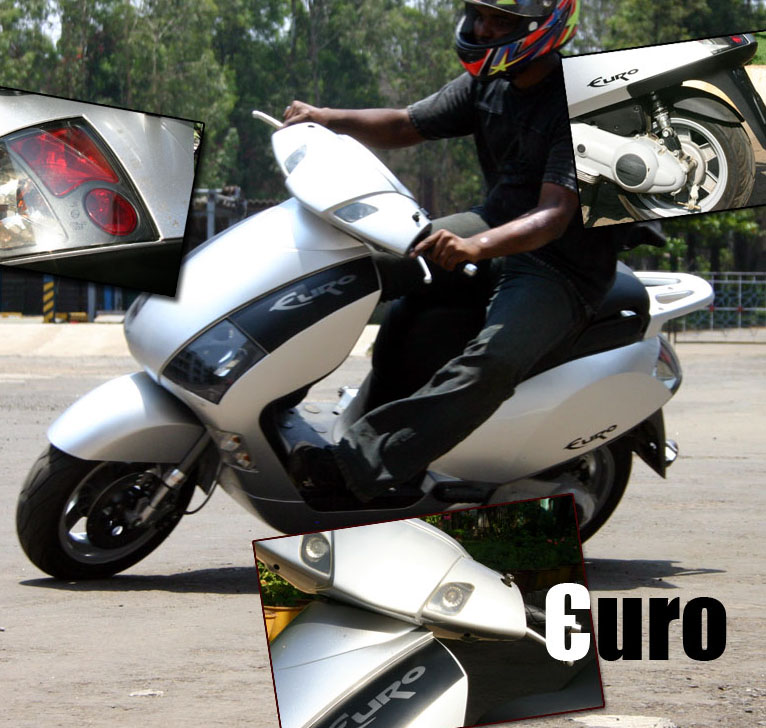
The first one to be rolled out will be the Euro brand of scooterrete, designed and developed by Italy-based Italjet. Euro is one of the seven models that the Kinetic group had bought from Italjet in 2004.

The Euro, powered by a 125-135 cc engine, will be priced higher than Honda Activa, Bajaj Wave and Hero Honda Pleasure, but will be cheaper than the company?s flagship and premium brand, the Blaze.

Sulajja Firodia Motwani, joint managing director, Kinetic Motors, said, ?The Euro will be aimed at the luxury segment and will cater to families and the executives alike. It will be a mix of class, comfort and power.?

Sources said the company stands to benefit from higher scale of business from the two-wheeler segment. KMCL expects aggressive sales growth during the current year on the strength of Italian scooters being launched as well as the upcoming launch of its new scooter through its collaboration with Sanyang Industry Company (SYM) of Taiwan.

The company?s next offering will be a four-stroke scooterrete developed by SYM, which holds 11.1 per cent stakes in KMCL. The bike will have an engine of less than or upto 100 cc capacity. The trial production of the bike is likely to begin in April this year followed by its launch in May.

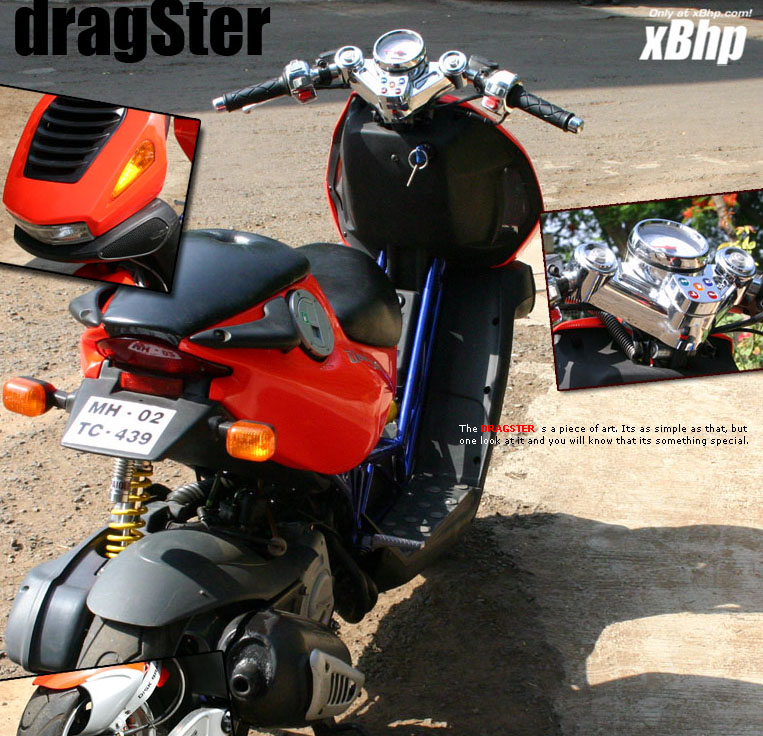
The last of the launches this year will be the Dragster brand of moto-scooter, which is co-owned by Italjet and KMCL. This is the only brand that is not completely bought out by the two-wheeler manufacturer, and may be launched by end-2007.

Source:- BusinessStandard
Pics source:- www.xbhp.com

Wednesday, January 31, 2007

Spy Pics of New Hero Honda Karizma R

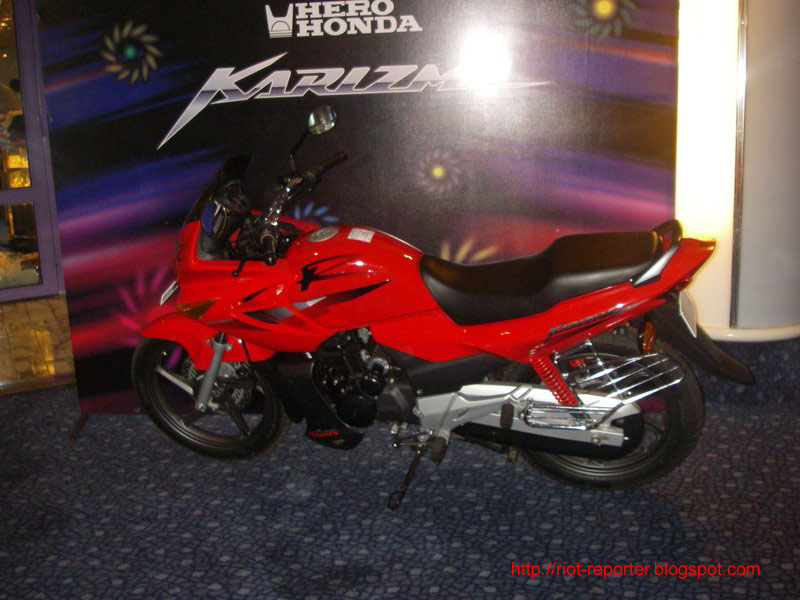
The pics you see in this page are of new soon to be launched Karizma R . No technical specifications are out yet but we expect the bike to Pack better performence than current Karizma. I have come to know that there is no fuel-injection in this karizma .

Bajaj Launches New Pulsar 200 DTS-i


Few days ago Bajaj launched there all New Pulsar 200 DTS-i. Technical specifications are as follows:-

ENGINE & TRANSMISSION:
  • Type Four stroke, Natural air cooled/oil cooled.
  • No. of cylinders One.
  • Bore 67 mm Stroke 56.4 mm
  • Engine displacement 198.8 cc
  • Compression ratio 9.5 *+* 0.5 : 1
  • Idling Speed 1400 *+*100 rpm.
  • Maximum net power 18 Ps (Bajaj figures convert directly to bhp)/13.25Kw
  • Maximum net torque 17.17 Nm/1.75kg
  • Ignition system Digital CDI
  • Ignition Timing 10° 1400 rpm 28° 3500 rpm
  • Fuel Unleaded petrol. Carburettor UCAL MIKUNI BS29
  • Spark Plug : 2Nos. Champion RG4HC (Resistive)
  • Spark plug gap0.6 to 0.8 mm
  • Lubrication Wet sump, Forced
  • Starting Electric Start only
  • Clutch Wet, multidisc type.
  • Transmission 5 speed constant mesh.
  • Primary reduction 3.47 : 1 (66/19)
  • Gear Ratios 1st 26.04 : 1 (36/13) 2nd 17.67 : 1 (32/17) 3rd 12.97 : 1 (29/21) 4th 10.15: 1
  • (26/24) 5th 8.65 : 1 (24/26)
  • Final Drive Ratio 2.71 : 1 (38/14)
CHASSIS & BODY
  • Frame type Double cradle type.
  • Suspension: Front Telescopic (Stroke - 130 mm.)
  • Rear Trailing arm with coaxial gas assisted hydraulic shock absorbers and coil springs.
  • Brakes:
  • Tyres: 90x90 X 17, 49P, Tubeless
  • Tyre pressure:
  • Rims : Front : 2.50 x 17
  • Fuel tank capacity15 litres.
  • Controls :* Steering Handle bar Accelerator Twist grip type on right hand side of handle bar. Gears Left foot pedal operated Clutch Lever operated on left side of handle bar. Choke Push-Pull knob on carburettor. Brakes Front :Lever operated on right side of handle bar. Rear : Pedal operated by right foot.
  • Length :2035 mm.
  • Width : 750 mm
  • Height :1165 mm.
  • Wheel base :1350 mm.
  • Turning circle radius : 2500 mm.
  • Ground Clearance:165mm.
  • Vehicle kerb weight: 145 Kg
  • Max. total weight : 280 Kg.
ELECTRICALS
  • System 12 Volts (D.C.)
  • Battery 12V 9Ah MF type
  • Head lamp 35/35 W Pilot lamp( 2 nos ,5 W each)
  • Tail/stop lamp LED/LED
  • Turn signal lamp :10 W
  • Turn signal pilot lamp : LED
  • Side stand indicator lamp : LED
  • Hi beam indicator lamp : LED
  • Neutral indicator lamp : LED
  • Speedometer lamp : LCD Display
  • Rear No. plate Lamp : 5 W
  • Horn :12 V DC
PERFORMANCE
  • Maximum speed :130 km/h with single rider (68 kg) (claimed)
  • Price :- 63,019 (ex-showroom) Pune
The above specs are taken from Yahoo Bajaj Pulsar Group.


Hands-On Report:-

The new Pulsar has a very sporty riding position. The handlebar is lowered a bit and foot pegs are also kicked back for sportier riding position. The bike has great acceleration and the acceleration is awesome. We found the vibes to be lower than Pulsar 180 kinda Unicornish. The new split seats (from Pulsar 220) look great and are comfortable.

The switchgear quality is top notch and paint quality is really good and seems like it will last long. The Headlight bulb and the pilot lamps (wolf eys) are white. They are Halonix 35/35W bulb i expected brighter Headlamps. Sadly u cannot put bigger bulbs without any mods as The headlight and pilot lamps are not on battery. They get their power from the alternator.

The bike is loaded with MRF Zapper Tubeless tires 90/90 at front 120/80 at back. The tubeless zappers have great grip. There is a Bigger 260mm disk upfront and a 130mm drum brake on rear. There is no chain cover. The bike uses O`ring sealed chain which promise to last longer than the chain used in other indian bikes.

Those who like Kicking better play Football, there is no Kick starter on this new Pulsar. The only way to start the bike is through Electric start and if the battery dies, u can always push start the bike. There is no harm push-starting a Carburated bike. The engine roars more and exhaust note is better. Company claims the top-whack to be 130km/hr but that can be known only after a full road-test. Watch out for this space and we will be bringing a full road-test soon.


Pics are taken by www.xBhp.com member Xionite

Merc to roll out new C-Class model

Luxury car manufacturer DaimlerChrysler�s Indian subsidiary Mercedes is all set to introduce the new C-Class in the domestic market by early 2008.
Recently at its unveiling, the new car attracted the attention of auto enthusiasts worldwide for its rather unorthodox design and style cues.
Sanjiv Sahajwala, director, sales and marketing, DaimlerChrysler India, said, �We are planning to launch the new C-Class, which is currently under production in the overseas market, in India by early next year. We would have to set up its basic equipment in our manufacturing units in the country in line with the new car. This will be done in the next 8-9 months.�
The company is planning to halt production of the current model by October this year.
DaimlerChrysler has not yet decided on the vehicle�s pricing, but experts said it might be priced on the lines of the outgoing model.

Source:- Business-Standard

Monday, January 29, 2007

Bajaj gears up for 4-wheel drive

Bajaj Auto (BAL) is planning a full-fledged foray into four-wheelers with a range of light passenger and goods carriers. The company has decided to set up a new plant for its four-wheelers and the location will either be Maharashtra or Uttaranchal.
The first ‘lite’ four-wheeler will roll out in 2009. While BAL has so far only spoken about launching one light vehicle, the company has now decided to roll out an entire ‘family’ of products to plug the ‘middle ground’ between two-wheelers and four-wheelers.
The proposed foray into this new segment forms part of BAL’s search for faster-than-industry-average growth. Speaking to Indiatimes Auto, Bajaj Auto’s managing director Rajiv Bajaj said, “The middle ground (between two and four wheelers) can spawn a range of ‘lite’ vehicles - a diet version if you will - and that’s something we will look at.
We are intending to get into a family of ‘lite’ four wheelers both for people and goods. We will get into that business first with a goods carrier.”
The ‘lite’ range, he said, will roll out of a new platform that Bajaj is currently developing. And the company will not look for any technology partner for this project. “It will be born out of our own skill and technical expertise so we can control the costs and there are no surprises,” Mr Bajaj said.
The whole idea for the ‘lite’ range came from a single question - “Can one conceive of a whole family of vehicles based on this middle ground?” said Mr Bajaj.
“Is it possible to keep things simple like two wheelers but offer the comfort and convenience of a four-wheeler in a way that’s affordable for the customer and profitable for the company? If we can, then we have a new business model.”
The alternative business model is also part of Bajaj Auto’s search for faster-than-industry-average growth. “Worldwide, the two wheeler market is fairly saturated and the four-wheeler market is also getting cut-throat,” said Mr Bajaj.
“So unless we think out of the box, we will be stuck with around 10% growth. Finding the middle ground between two and four-wheelers is one such strategy to break beyond 10% growth curve,” he explained.
Bajaj is not the only two-wheeler major to foray into four-wheelers. Arch rivals Munjals of Hero group have also announced their intentions to get into four-wheelers though it isn’t clear whether the foray will be into passenger or goods carriers.
In an earlier interview with Indiatimes Auto, Hero Honda MD Pawan Kant Munjal maintained that he never said Hero group will get into cars, only four-wheelers. Meanwhile Hero’s Japanese partner Honda has already voiced its discomfort with the idea of Hero getting into the car business.
Bajaj Auto is also cranking up its retail strategy for higher-end bikes with the company-owned Probiking showrooms. “Right now the line up includes the Pulsar and Avenger but hopefully in future there will be bigger bikes,” Mr Bajaj said.
“Out of our total network coverage of 52 towns, BAL is directly selling in 6 through the Probiking showrooms. In the next 12-24 months, we want to be present in all 52 towns.”
These showrooms will cater to the “trend setter customer. By next year, we should be selling 5% of the three million bikes we sell annually ourselves through this channel,” he added.
As for changing equations with Japanese partner Kawasaki as Bajaj Auto moves away from the 100cc/four-stroke market, Mr Bajaj admitted there was a “lull” in the relationship but added that a “partnership isn’t so cut and dried. We carry a huge obligation towards them and we are discharging our dues”.
Even though Kawasaki’s contribution to the CT100 is almost zero, BAL still pays a royalty. “We are investing in future technology,” Mr Bajaj said. “As India matures and bigger bikes take off, I can go nowhere else but to Kawasaki.”
As for how the equation will change if Bajaj partners with another global player (industry reports say the company is in talks with Yamaha for a joint venture), Mr Bajaj said, “Hypothetically even if Bajaj partners with someone else that could easily be a separate company. Bajaj R&D, that works with Kawasaki, will have very little role there.
We would always like to continue the relationship between BAL and Kawasaki.”

Source:- Indiatimes Auto

Thursday, January 25, 2007

Swift joins D-company to challenge Tatas

By launching a diesel Swift, Maruti Udyog has challenged the Tatas for supremacy in the B and C segments, where the Indica and Indigo diesels dominate. In the process, it is also taking competition to the doorsteps of companies like Hyundai and General Motors.

Not only has Maruti fitted the diesel Swift with a 1.3 litre DDiS (common rail diesel technology) engine which is Euro IV compliant, but the company has also managed to price the product aggressively “under Rs 5 lakh” psychological barrier. The company claims that this engine is the smallest 4-cylinder diesel engine for passenger cars anywhere in the world. Maruti is manufacturing the new engine at its Manesar plant, which has initial installed capacity of one lakh units per year but will be scaled up to 3 lakh units with a total investment of Rs 2,500 crore.

There are no other diesel hatchbacks now in India except the Tata Indica; they mostly exist in the larger, sedan cars with prices significantly higher than the Swift diesel variant. So what Swift diesel could do is bridge the gap between petrol hatchbacks and expensive sedans for customers wanting to buy a low-priced diesel car.

Says managing director Jagdish Khattar: “This car is the most fuel- efficient diesel car in India.”

Maruti claims the car can give 21 km per litre on highways and 14-15 km per litre in normal city-driving conditions. The base model called Ldi is priced at Rs 4.68 lakh while the Vdi comes for Rs 4.96 lakh (both prices ex-showroom Delhi).

About the development of this engine, Khattar said that over the past few months it has been localised to 70% but more work needs to be done.

But with Maruti getting aggressive in diesel, is competition sitting pretty? Hyundai is believed to be putting together diesel engines for the Getz and the Santro. The recently launched Chevrolet U-VA may come with a diesel engine and the brand new Dicor engine for the Tata Indica may also become a reality soon. What remains to be seen is whether the customer laps up a lower-priced diesel variant.

Typically, the Indian perception of diesel cars has been vehicles that make noise and require more maintenance than the petrol counterparts. The common rail technology of Swift could well change this perception. Then, diesel is at least 30% more fuel efficient than petrol and this price equation may also lead to a surge in diesel car buyers in the coming months.

Khattar dares Tata in Singur, too

Maruti Udyog’s managing director Jagdish Khattar on Wednesday asked Tata Group chairman Ratan Tata to clarify his allegation that a competitor was behind the Singur furore. “I don’t know which competitor he (Tata) is talking about. Since he has the knowledge, he should tell it.” Khattar added: “We believe in healthy competition.” Last month, Tata alleged that he suspected competitors to be behind the controversy at Singur in West Bengal, where the Tatas are setting up a manufacturing
plant for their Rs 1 lakh car.

Source:- DNA-Money

Hopkins heats up test

AMERICAN John Hopkins of Team Rizla Suzuki stamped his mark to lead the first MotoGP test session for 2007, which entered the final day under blue skies and glowing sunshine at the Sepang Circuit yesterday. After setting the fastest time on the first two days and upstaging more prominent riders, Hopkins continued his awesome form on his Suzuki GSV-R800 machine by topping yesterday’s morning session with a time of 2 minutes 01.026 seconds.

Bettering Monday’s fastest time of 2:01.806s, Hopkins prompted growing discussion across the paddock with various new theories over his performance, effectively making him the man to watch this season.

Hopkins, however, was quick to play down the attention by saying it was still a long way before the new season opens in Qatar on March 10 and that there was still plenty of testing and development to be done by all teams.

“Naturally, all the other teams will improve with all the other tests before the season starts.

“The bike is working very well. Obviously, Suzuki has upped their level of competitiveness and we need to continue the good work,he added.

The superb speed of the new GSV-R800 machine was further underlined by the performance of Hopkins’ Australian teammate Chris Vermeulen, who was second fastest with a time of 2:01.691s.

Kawasaki’s Randy du Puniet was third fastest with 2:01.878s while five-time MotoGP champion Valentino Rossi was sixth with 2:02.354s.

Clearly focusing on the new development aspects of his RC212V machine, world champion Nicky Hayden was surprisingly eighth with a time of 2:02.701s.

“We actually learnt quite a lot about how the new bike worked yesterday and we improved by almost half a second so it’s nice to see some progress, said Hayden, the Repsol Honda rider.

“We weren’t testing new parts, just working with suspension, wheelbase, springs – general settings for the bike to go a little bit quicker.

After Sepang, the teams will head to Phillip Island, Melbourne, for another three-day testing from Jan 30 before returning to Sepang for a tough second round of testing from Feb 5-7.

source:- MalayMail

Wednesday, January 24, 2007

Hydrogen-CNG combo fuel for Vehicles

The quest for a sustainable source of fuel supply has brought India’s automobile rivals together. Tata Motors, Bajaj Auto, Mahindra & Mahindra, Ashok Leyland and Eicher Motors have joined hands under the aegis of the Society of Indian Automobile Manufacturers (SIAM) to participate in a first-of-its-kind project to create an optimal mix of hydrogen and compressed natural gas (CNG). The idea is to make the fuel mix usable in existing vehicles.

The world over, vehicle makers are looking for ways to use hydrogen fuel in new products, but this project seeks to develop the CNG-hydrogen mixture (called Hithane) for use in the existing on-road fleet of vehicles with minimum modifications in the engine and engine components.

The participating companies are providing seven different types of vehicles for this Rs 5 crore project, which is being done in partnership with the ministry of new and renewable energy. In fact, SIAM and the ministry are expected to sign a memorandum for the purpose soon.

During the course of the project, all vehicles - three light commercial vehicles (LCVs), two three-wheelers, a sports utility vehicle (SUV) and a passenger car - will be first tested on various blends of Hithane. Blends containing between 10-30% of hydrogen will be tested to get to the optimum blend that reduces emissions and achieves the desired fuel supply sustainability. Thereafter, this blend will be used to modify vehicle engines for optimum performance with the new fuel.

The hydrogen needed for this project will be sourced from Indian Oil and a hydrogen station is expected to come up at the Central Government Officers’ Complex in Delhi. Hithane not only reduces dependence on foreign oil, but also cuts down on NOX (nitrous oxide) emissions and helps achieve better fuel efficiency.

In a hydrogen engine, electricity generated from solar power is used to split water into hydrogen and oxygen. Oxygen is released into the atmosphere, while hydrogen is liquefied and stored at a very low temperature (-253 °C). During internal combustion, the hydrogen combines with oxygen and the resulting energy powers the vehicle, while the hydrogen is returned to the environment as water.

However, several issues have to be addressed before viable hydrogen engines can be developed indigenously. Explains Arun Jaura, senior vice-president (R&D and Product Development) at M&M: “Use of hydrogen in vehicles poses several challenges such as its availability, distribution, on-board storage and safety. The SIAM project is the first step towards looking for a viable use of hydrogen in automobiles in the Indian context.” M&M has already made a beginning with hydrogen - by showcasing a concept vehicle called HY-Alpha Champion - a sub-one tonne three-wheeler which runs on compressed hydrogen gas.

Source:- DNAIndia

Rolls-Royce Phantom Drophead Coupe Launching In India

This would be their latest offering for the Indian consumer and they hope to perform well by selling good numbers of this car in India.

Ian Robertson CEO, Rolls-Royce spoke about their Indian ambitions: “I think it’ll have a very positive reception. Many of the older convertibles, dating right back to the ’20s and ’30s are in India today. So, we anticipate this will have a strong hold in our sales, going forward.”

The company in order to expand their availability would be opening its second Indian outlet in New Delhi. Their first dealership was opened in Mumbai in 2005. Rolls Royce hopes to attract more millionaires to their vehicles.

Robertson added: “I think there are still maharajahs who are buying these cars but we are also seeing the introduction of the car to many new entrepreneurs - people who have started up their businesses, people who have seen a great deal of success in just a few years. And from that perspective, right across Asia, we see a much younger profile in our overall sales now.”

Source:- AutoIndia

Bajaj Auto keen on China if it opens up

Chinese restrictions on foreign ownership are hindering one of the developing world's largest motorcycle companies from tapping into what could be a lucrative market.

Rahul Bajaj, chairman of Bajaj Auto Ltd, says India's second-biggest motorcycle maker would expand into China, but only if it were able to gain majority foreign ownership, which is currently barred in some sectors including automobiles.

Five years into China's membership in the World Trade Organisation, pressure is growing on the government to open up various sectors of the economy.

"We are expanding very fast in international markets. The only big country (in which) we are not planning anything at the moment is China, because I don't get majority foreign equity," Bajaj said on Tuesday in an interview on the sidelines of the World Economic Forum.

"I want ownership. I can get at most 50 per cent, and I don't like that. That's why I'm saying India is a more open economy than China. (I'm interested in) 100 per cent. If I'm allowed majority foreign equity, I enter," said Bajaj, who has attended the Davos gathering of business and political leaders for nearly 30 years.

Bajaj, which has more than 35 per cent of the Indian motorbike market, has expanded into Indonesia, Southeast Asia's biggest economy, as well as into countries such as Nigeria, Iran and Brazil, which have big two-wheeler and three-wheeler markets.


Source:- EconomicTimes

Metro Tyres To Roll Out Tubeless Motorcycle Tyres For Domestic And International

Metro Tyres – India‘s one of the leading tyres manufacturers is planning to roll out Tubeless motorcycle tyres in technical collaboration with continental AG of Germany. These tyres will be manufactured primarily for overseas markets to cater to the demand of tubeless tyres among the global two wheeler players like Honda, BMW and Yamaha etc.

Later on Metro will also roll out these tubeless motorcycle tyres in the domestic market.

Mr. Jorg Essiger, Managing Director, Continental AG, Germany who is especially here to finalize the details said, “We are witnessing an equal demand for Tubeless motorcycle Tyres in Asian market too as in Europe. And to cater to this growing market we are rolling out Tube less motorcycle tyres in partnership with Metro Tyres, for which all the required technical know how Continental is providing.

“On the occasion Mr. Max, R & D Head Continental AG, Japan said, “ India is going to be a major export hub for the two wheeler industry particularly for motorcycle and we at continental will further fueling the growth by flitting up Tubeless Tyres that are of international Standard, ECE approved, Technological superior with much longer life”

Metro Tyres will manufacture these tubeless tyres in its existing state -of –the- art plants at Ludhiana and the company is in the process of upgrading & installing the necessary infrastructure, required to manufacture these tyres.


Source:- AutoIndia


Tuesday, January 23, 2007

Suzuki launches 4 new motorcycle variants

Suzuki Motorcycle India, a subsidiary of leading Japanese two-wheeler manufacturer Suzuki Motor Corporation, today introduced four upgraded models of its existing motorcycles, 'Zeus' and 'Heat'.

The new variants of 'Zeus' would be available at a price range of Rs 42,725 and Rs 46,326, whereas the new 'Heat' variant would be tagged at Rs 35,100 ex-showroom Delhi. The new introductions are part of plans to meet the demand for the 125 cc segment, the company said in a statement.

"Zeus & Heat-- our two motorcycles, which were launched in 2006, have had positive response from consumers. We are sure that the upgraded versions will exceed customer expectations in all aspects," Suzuki Motorcycle India, Joint Managing Director, Katsumi Takata said.

The company is targetting students and executives looking for contemporary style and performance with the three new variants of Zeus and the upgraded Heat.


Source :- The Hindu


Premium segment motorcycles on their way?


Some people are upset about how long it has taken Bajaj to get the Pulsar 220 DTS-Fi off the AutoExpo'06 showstand and into showrooms – a bit more than a full year. Regular sales are expected to begin next month. We haven't seen a launch like this before, with so much speculation, excitement and lots of information preceding the launch. Enthusiasts (and indeed, the competition) knew a fair bit of what was coming and this fuelled the anticipation of one of the most important motorbike launches in India recently.

There are a number of reasons why the 220 is such a fulcrum. First, the market. With margins under pressure and competition rising, the segment in focus is the premium segment – one which Bajaj has more or less 'owned' since they launched the first Pulsar years ago. It is where bike makers can make half decent per-unit margins and inasmuch, the sales 'subsidise' more price-competitive segment sales to some degree. Second, the premium bikes have (admittedly on a smaller base) grown at a pace that far outstrips the sales of entry/executive commuters. This is where the action is.

Third, most bike makers realise that we are ready to hop, skip and jump up the pecking order. What remains to be seen are the actual volumes. The flop that was the BMW Funduro and the long but ultimately futile attempt to launch the Yamaha Drag Star are signs of scared MBAs out there who won't nod 'Yes' to big bikes,
unless they see precedents.

The 220 should set that precedent. Enthusiasts already know the impressive spec list by heart. There is lots of new technology on the bike, including fuel injection, tubeless tyres, projector headlamps, LED tail lamps etc, each with a clear benefit and application. Despite which, Bajaj have pulled out a rabbit-from-a-hat price tag. All that costs only Rs 83,595 on-road Pune.

e road tested the bike, and it is no less impressive in the flesh. We aren't sure that making all Pulsars look so similar is such a great idea, but the 220 does have presence. The 220cc motor is good for 20.5 bhp – it destroys all previous 0-100 kph and top speed times for bikes. But making a bigger motor go faster is easy. What is really great is the 220's dynamic ability. Despite being a fair bit longer than the smaller Pulsars, the 220 is very quick and confident in corners, and most bikes in India would find it hard to keep up. That it rides very well over broken roads and brakes with great composure is a bonus. What we're saying is that on the whole – product, packaging and pricing – Bajaj have more or less hit the nail square on the head. I wouldn't be surprised at all if there aren't enough 220s to go around. Rs 90,000 has a way of disappearing when broken up into EMIs.

If this happens, it will send the right signals to other marques. The Hero Honda Karizma, already rumoured to be in for upgrades, will feel the brunt of the heat. Its displacement and price put it directly in the 220s crosshairs and in its current spec, it will find the road uphill. Unexpected 220 sales volumes will also push companies like Honda and Yamaha, who in product range terms are at the cusp of entering the premium segment with competitive motorcycles. Rumours are rife that Yamaha have a 220-sized product in the final stages. Even if untrue, it's a good rumour. If I were Yamaha, that's what I'd be doing.

The Bajaj 220, in essence, is opening a door to higher displacements to the average Indian motorcycle enthusiast. Bajaj have already stated on record that they have a larger displacement platform in development. We expect a 300 or 400cc single around September 2008 to be the first product from that platform. Other manufacturers, including the three Japanese marques, are also looking for ways to directly import bigger capacity motorcycles to India shortly. Like we said, this is where the action is.

Source:- BsMotoring

Now pay for 1 litre, drive 700 km


They've got a slow pick-up and can do just 25 kilometers an hour but they carry a price tag that's irresistible. They'll take you 700 kilometres for the price of one litre of petrol and that's what pulls scooter and bike lovers to the e-bike fold.

Orpat will join e-bike makers who believe that if China produces and sells two lakh e-bikes a day, India can do it too. An AC Nielson survey indicates potential for sale of nine lakh e-bikes a year in India.

"We are planning a big project at a cost of around Rs 300-400 crore in Kutch, wherein a combination of new technology will be put in for e-bike. We are planning that plant,” Director of Orpat Group, Jaysukh Patel says.

Electrotherm, which makes Yo Bykes, has begun work to triple its e-bike manufacturing capacity. Although priced higher than traditional two-wheelers, competition is expected to cut 40 per cent off its price tag. Besides, manufacturers are working on faster models and that will put some pace in the market.

“Total number of vehicles are 60-65 million, out of the population of 1,200 million. Present manufacturers are meeting miniscule needs for vehicles,” MD of Electrotherm, Mukesh Bhandari says.


Source:- IbnLive

Wednesday, December 06, 2006

Honda Rolls Out World’s First Motorcycle Airbag

Along with Deadly features ike satellite navigation, 80-watt per channel premium audio with six-element speaker system, a cold-weather comfort package which includes foot-warming system channelizing engine-heated air over the rider’s feet and is controlled by a fairing-mounted lever, the new Honda Gold Wing comes with first protection airbag system.

The safety airbag fixed between the handlebars will be able to absorb some of the forward thrust during an accident, but only when the driver is still on its seat after the crash, which I doubt will ever happen on that speed…better take a bicycle, if not tempted to roll your wrist full on these wings.

Don’t think twice while shelling out $22,800, it’s worth it.

Source

World's First Fuel Cell Motorcycle


This is ENV, the world's first purpose-built, fuel-cell motorbike - ahead of any of the world's leading automotive companies. The ENV bike is the creation of Intelligent Energy, a British energy solutions company, whose board includes Chairman Sir John Jennings, the former Chairman of Shell Transport and Trading.

The ENV (Emissions Neutral Vehicle) bike was designed to Intelligent Energy's brief by a British team, led by multi-award-winning designers Seymourpowell. The ENV bike is fully-functioning and has been engineered and purpose-built (based around Intelligent Energy's CORE fuel cell) from the ground up, demonstrating the real, everyday applicability of fuel cell technology. The CORE, which is completely detachable from the bike, is a radically compact and efficient fuel cell, capable of powering anything from a motorboat to a small domestic property.

The ENV bike is different. It offers an exhilarating glimpse of what can be achieved: a great-looking and exciting fuel-cell motorbike. "In the none-too-distant future", commented Intelligent Energy CEO Harry Bradbury, "people will be able to use a bike like ENV to leave work in an urban environment, drive to the countryside, detach the CORE and attach it to another vehicle, such as a motorboat, before going on to power a log cabin with the very same fuel cell, which could then be re-charged from a mini hydrogen creator, the size of a shoebox."

The ENV motorcycle

ENV is lightweight, streamlined and aerodynamic. In an urban or off-road environment, it can reach speeds of 50 mph. It is also virtually silent (with noise emissions equivalent to an everyday home computer) and its emissions are almost completely clean. On a full tank, the ENV bike could be used continually for up to four hours without any need for re-fuelling. The bike can also be used by riders of any skill level with simple controls, via a throttle directly linked to the applied power. The bike has no gears and is strictly defined as a motorbike, although it feels to riders more like a very quick and responsive mountain bike. "ENV is light, fast and fun", commented Seymourpowell director Nick Talbot. "It has good ground clearance, great off-road suspension travel and a very carefully considered power to weight ratio. I have ridden motorbikes for years", he added, "and, in the process of designing the bike, I have become a convert to fuel cell technology. The bike is usable, useful and great-looking. It was important on this project to demonstrate that new technologies don't have to be wrapped up in a dull product ­ engaging public imagination and enthusiasm is key."

ENV has been produced in two monochromatic colourways: black supergloss and iridescent white. 'This was to express the bike's parallel natures', explained Nick Talbot. "On the one hand, it expresses a utopian future vision of clean power, anywhere - and on the other, it's an exciting, hard-edged bike and fun to ride."

The bike's primary frame and swinging arm are made from hollow-cast aircraft grade aluminium. At the bike's heart is a fully-integrated 1kW fuel cell generator providing power on demand directly to the drive-train. To enhance performance during peak power demand (ie when accelerating), the fuel cell is hybridised with a battery pack to provide a 6kW peak load to the motor. The result is a balanced hybrid concept which combines the main advantages of Intelligent Energy's CORE fuel cell, hydrogen storage and battery technology."

The design of the CORE

"When it came to designing the casing for the CORE", commented Seymourpowell's Nick Talbot, "we treated it as a standalone project, giving this radical fuel cell its due as a beautiful, valuable and useful energy resource. The CORE, which can be detached completely from the bike, is therefore designed to create interest as an enigmatic object. Although mostly encased in identical aluminium to the bike, of which it at first seems a completely integral part, the CORE is also part-covered on one plane in a micro-etched, textured and durable shell, in a pattern derived from brain coral. The pattern alludes to the fact that this is solid state technology ­ but is also functional, in that the intricate patterns also disperse heat. We wanted this to be a finer and more beautiful object than, say, a diesel generator - and to make people look again at this new technology with a sense of wonder."

"The launch of ENV breaks new ground and opens up a whole new field of opportunities for low- and high-power fuel cell motorbikes,' commented Harry Bradbury. 'ENV and its successors are good for the consumer and the environment. This is a fun vehicle with a realistic role to play in the leisure environment, as well as a role in emissions reduction from Boston to Bangkok. There has been much talk about low-carbon emission vehicles. Here is one at last."

Key Components of the Bike Power System

Motor - 6kW, 48 VDC Brush motor (model LEM-170, supplied by LMC)
Motor Controller - Brusa Direct Current (model MD 206)
Fuel Cell - 1kW Intelligent Energy air-cooled (2 x AC32-48)
Hydrogen Storage - High pressure carbon composite cylinder (Luxfer L65)
Hydrogen Energy - 2.4kWeh
Storage Battery - 4 x 12V Lead Acid (15Ahr) connected in series

Performance Data

Acceleration - 0 ­ 20 mph in 4.3s (32kph), 0 ­ 30 mph in 7.3s (48 kph), 0 ­ 50 mph in 12.1s (80kph)
Top speed - 50 mph (80kph) (note: ENV has been tested to 50mph ­ however, with further refinements and redevelopments, this top speed is expected to be exceeded)
Range - At least 100 miles (160km)

Physical

Bike mass - 80 kg (Total mass including CORE)

Fuel

Hydrogen - 99.9% purity
Oxygen - Taken from air
Hydrogen refuel time less than 5 minutes

Interface

Electrical connection - Multi-core (Intelligent Energy specific)

Source:- Rubbermag

Maruti Udyog Launches All-New Zen Estilo


Maruti Udyog Limited has reinvented the Zen as the Zen Estilo to take on new competitors in the compact car segment.

Hyundai Motors, General Motors, Honda Siel and Volkswagen are gearing up to enter the compact car segment and analysts believe this has forced Maruti to reinvent its popular offering.

Priced between Rs 3.19 lakh and Rs 4.24 lakh (ex-showroom, Delhi) across its four variants — Lx, Lxi, Vxi and Vxi with the anti-lock breaking system (ABS) — the Estilo comes with a 1061-cc engine delivering a torque of 64 bhp. The earlier Zen had a 990-cc engine.

The car replaces the first-generation Zen, which Maruti withdrew about eight months ago.

Launched in 1993, the Zen became one of Maruti’s most popular models next only to its cheapest offering, the Maruti 800. The company sold 7,60,000 Zens, including exports of over 1,22,000.

The new car will be pitted against Hyundai’s Santro and Getz, Tata Motor’s Indica and may also eat into the sales of Maruti’s own popular models, the Swift and Wagon R.

The Zen Estilo — a Spanish term for style — is built on Suzuki’s popular hatchback MR Wagon. It has been put together to conform to the standards of a rigid ‘monoform’ design with smart interiors and distinctive aerodynamics.

“Young people in India today desire products with contemporary styling and international appeal. The new Zen will appeal to this new India, just as the original Zen appealed to the India of the mid-1990s. It incorporates features and attributes that are uniquely suited to the country,” said Maruti MD Jagdish Khattar.

The car will be available in purple fusion, champagne beige, virgin blue and olive green.

Source:- The telegraph

Tuesday, December 05, 2006

Motorcycle Land Speed Record pushed to 350 mph


Denis Manning’s motorcycles have been chasing world land speed records for over three decades and in September, the BUB 7 Streamliner he designed and built captured the ultimate goal when it set the new absolute motorcycle land speed record at Utah’s Bonneville Salt Flats. Rider Chris Carr piloted the BUB 7 streamliner to 354.832 mph on the down run and 346.939 mph on the return for an average speed of 350.885 mph, a new world record. Prior to the 2006 BUB Motorcycle Speed Trials the absolute motorcycle land speed record had not been broken since Dave Campos achieved his 322.149 mph world record run in 1990.
Of course, building the world's fastest motorcycle from the ground up is nothing new to Manning. In 1970 another Manning-built streamliner earned the title of world's fastest motorcycle. That machine was driven 265.492mph by legendary road racer Cal Rayborn.

In over 30 years of chasing land speed records Denis Manning, and his team, have overcome some unique challenges in order to reach success. In September 2007, they will once more return to the salt to defend their absolute motorcycle land speed title at the fourth annual gathering of the world’s fastest motorcycles, the BUB Motorcycle Speed Trials scheduled for September 2 – 6, 2007. Competitors from around the globe will again meet on the Utah’s legendary Bonneville Salt Flats. The FIM (Federation Internationale de Motocyclisme) and AMA (American Motorcyclist Association) sanctioned event is the only land speed racing meet solely dedicated to motorcycles, offering the world’s top builders and racers the opportunity to break world and national speed records.

Denis Manning, a 2006 inductee in the Motorcycle Hall of Fame, is the designer, builder, and owner of the BUB #7 streamliner – and no stranger to record-breaking speed. In 1970 another Manning-designed streamliner was the fastest motorcycle in the world. That year Cal Rayborn piloted Manning’s streamliner at the Bonneville Salt Flats to a two-way average of 265.492.

The current world-record setting BUB streamliner, the “#7” sponsored by Drag Specialties & Parts Unlimited, is so named because it is the seventh streamliner Denis Manning has designed and crafted. The streamliner features numerous engineering firsts, including a 3000cc, 425hp engine purpose-designed and built for land speed racing. Says Manning, “The goal is to continue developing and testing the #7 streamliner. We hope to retain the record at the next BUB Motorcycle Speed Trials. Our dedication and hard-work paid off this year. I have no doubt next year will be just as exciting.”

Source:- Gizmag

Setting out on a dream mission


It has been a dream for Srinidhi L. Raghavendra and Kishore Patwardhan and now they can't wait to fulfil it. Avid bikers, they have been aiming to do a trans-country journey on two wheels and now they are off on a 25,000 km trip through South Asia. Although first comes their passion for riding, they hope to spread awareness on the importance of "quality education for all" and promote Karnataka as an untapped tourist destination.

Mr. Raghavendra, 32, is a journalist and Mr. Patwardhan, 34, is in the real estate business. They call themselves Borderlessbikers.

Their journey will take them through India, Pakistan, Nepal, Bhutan, Bangladesh, Myanmar, Thailand and Sri Lanka. "We will be travelling through regions which have some of the largest illiterate populations in the world, so that's why we have chosen education as our mission motto," they say.

The two themselves are financing the trip but various sponsors have chipped in with materials, principally TVS which has given them two Apache motorcycles. Also Rotary International has offered support in all the countries they will visit.

The rally will be flagged off on December 3 at 10.30 a.m. from the Mahatma Gandhi statue, M.G. Road, by K.C. Ramamurthy, Commissioner of Youth Services and Sports and Director-General of Sports Authority of Karnataka and R. Chandramouli, Vice-President, Marketing, TVS. You can follow their journey online at www.borderlessbikers.com.


Source:- TheHindu

60 new two-wheeler models in next one yr

Call it novelty value or the increasing appetite of the Indian customer. The two-wheeler industry is churning out new models at fast intervals to maintain the sales momentum with over 60 fresh launches scheduled in the next one year.
With every new launch, the automobile companies are able to leverage the dual benefit of beating the rising input costs, by upgrading their existing product line, and keeping their customer base intact by catering to the demand for diverse new products.
Pradeep Saxena, senior vice-president, TNS Automotive says: "It takes a lot of time and investment for a company to raise a new product. The main components -- engine and frame -- takes years to develop, so does a new production platform and all these consume huge investments. So the companies have taken the easy route of entering into a cyclic-product launch, which are basically an extension of showcasing their existing brands frequently."
Following the same trend, last Friday, Hero Honda brought out two of its current 100 cc models -- CD Deluxe and CD Dawn -- as new launches, by refining its engines and modifying looks.
Toeing the same line, TVS Motors added an electric-start option to its current entry level 100 cc brand, StaR City, and showcased it as a new launch.
"The consumers are very price conscious. They want newer products without any extra price tag. By adding a few cosmetic features, companies are able to offer a new product at the same price. A new launch has turned out to be the most cost-effective method of generating heat in the market and attracting potential customers, prompting companies to regularly branch out launches as new offerings," said a senior official of the Society of Indian Automobile Manufacturers.

Source:- Business-Standard
Automobiles are no longer seen only as a mode of transport. Customers perceive them as an extension of their personality and are demanding variety at regular intervals. To meet their tastes and demands, auto companies are betting at these frequent launches.
S Shridhar, vice-president, Bajaj Auto says: "People want change and we are offering it without adding any cost to it. For us, marketing expenditure is almost equal to the cost of developing a new product. We spend huge amounts on marketing products to customers. Re-launching of the same brand as different variants at regular intervals help us leverage these costs as well as satisfy customers� aspirations."
New features like fuel injection systems, real time mileage indicators, aerodynamic styling, and a dual disk brakes system will help companies keep their flags flying for the next one year at least.

Monday, December 04, 2006

Hero Honda launches two "new" bikes


Hero Honda Motors Ltd. (HHML) on Friday announced the launch of its new CD Deluxe and CD Dawn in a bid to consolidate its position in the entry-level segment of motorcycles.

The CD Dawn comes with a completely new engine and improved performance, large multi-reflector light, new fuel tank and a host of other features.

The engine is based on Honda's `Econo' series engine.

While the CD Deluxe is priced at Rs. 34,900 (ex-showroom Delhi), the CD Dawn is priced at Rs. 31,900 (ex-showroom Delhi). HHL has had the CD brand for the last 21 years.

Addressing the media here, Pawan Munjal, Managing Director, HHML, said, "Our strategy is to strengthen our leadership position in the two-wheeler market as competition is following closely. To maintain our leadership and again increase the gap, we are energising our portfolio.''

HHML has lost the market share in the entry-level bikes from 42 per cent to 39 per cent.

However, in the premium segment, it has maintained its market share at 10 per cent and in the deluxe segment it has gone up from 48 per cent to 51 per cent.

In October, HHML despatched 3.60 lakh units and retailed 5.30 lakh units. "We sell between 60,000 and 70,000 units of the CD range a month — close to one million units annually.

The CD series accounts for about 20 per cent of our total bike sales and we are looking to grow the CD series by 20-25 per cent in the coming year,'' Mr. Munjal said.

With the latest launch, the company has introduced six new variants in the current financial year and it will launch two more variants before the year-end, according to Mr. Munjal. "The whole industry is growing and the 100 cc motorbike segment will continue to grow and remains an important segment for us.''

Source :- TheHindu

Bikers` Harley Davidson dream may be for real

The decks could soon be cleared for the import of Harley Davidson motorbikes into the country. While the high-end bikes will not enjoy any cuts on import duty, the commerce ministry has now mooted capping the number of such bikes to be imported in a year.

It has also softened its stance on emission norms and indicated to the US that Euro norms were likely to be accepted.

However, the export of Indian mangoes continues to face hurdles, with the US now saying that Indian exporters could have to pay as much as half a dollar per mango towards �facility creation charge,� which includes costs on inspection and sanitary checks.

The two issues were discussed at a meeting of the India-US Trade Policy Forum here yesterday.

Officials said the commerce ministry indicated at the meeting that it would begin a dialogue with the surface transport ministry to recognise Euro emission norms for Harley Davidson motorcycles.

There was earlier a view to have separate emission norms for these bikes since current regulations in India do not prescribe any standards for high-end motorcycles.

However, the ministry has made it clear that it will not be able to offer any duty cuts on the import of bikes, which stand at over 60 per cent.

�The US side is also aware that any reduction in import duty is in the domain of the finance ministry,� an official said.

Officials said the US was not opposed to a quota since it had earlier said it was looking to sell around 10,000 motorbikes in 10 years.

Harley-Davidson is known for delivering �quality nostalgia,� and is loved for its �time warped� designs. Founded in 1903, the company reported global revenues of $5.34 billion in 2005, with a net income of $960 million.

Regarding mangoes, officials said a team of American officials would be visiting Indian orchards on December 18. �We are still hopeful that both sides will come to some understanding regarding mango exports,� an official said.

The US has not allowed import of Indian mangoes so far, citing its stringent sanitary and phyto-sanitary norms.

Source:- Business-Standard

Motorcycle diaries


From the engineer next door to the hotelier down the street, the new biking culture is being spawned by guys-next-door. Nida Mariam finds out who is riding these mean machines on Mumbai streets

Only in that rare instance that a stretch of Marine Drive comes clear does a biker riding a 1000 cc bike dare to open up the throttle and blast across the horizon. His 167 bhp engine takes just six seconds to exceed 200 kmph and while he wants nothing else but to hold it there, he knows that maximum city cannot contain that sort of speed (just as he enters his element and his body begins to feel the rush of the ride, he has reached the end of the road). An odd sort of situation in that quintessential space crunch, it becomes imperative that he brake.

Super bikers in Mumbai, numbering around an estimated thousand, come from all walks of life—from the medical profession to the entertainment industry. While some of them ride alone, others enjoy riding together for confidence and camaraderie. Dealers in the city confirm that the past year has seen the sales of the Suzuki Hayabusa — John Abraham’s bike in Dhoom 1 — go up significantly. But these engineers, businessmen, producers, have no claims to Kabir — the badmash played by Abraham in the movie-and his gang. They are just a bunch of ordinary guys who revel in the sense of freedom that biking gives them. Riyaz Amlani, an hotelier in Mumbai who rides a Suzuki Intruder M 1800 R, said while explaining the thrill, “A bike and an open road is the closest thing that comes to flying.” The culture of biking and brotherhood has caught on, and groups like the Mocha Bikers Association (MBA), founded six months ago on the enthusiasm of Amit Jambotkar, are new and legitimate forums open to all super bikers from around Mumbai.

Kersi is part of that culture and in 2004 when he decided it was time to upgrade, he sold the Honda CBR 400 RR he had bought with his hard-earned savings and invested in some mutual funds. A few months ago he bought his dream bike, the Suzuki GSX-R1000, popularly know as the ‘GIXER’. Bike enthusiasts pay duties up to 120 per cent to import bikes which end up costing them anywhere from seven lakhs to 12 lakhs.

But sport bikes aren’t child’s play. Twenty-eight-year-old Kersi and his friend 24-year-old Afshad are mindful of the fact that the Suzuki Hayabusa — the king of bikes-is mighty dangerous; injury or death could be the slightest slip or fall. Kersi occasionally rides in a group of eight or nine passionate bikers in South Mumbai whose emphatic emphasis on safety and caution is telling of their family and professional backgrounds.

When 27-year-old Baman, an employee at an American multi-national company, moved up from his Yamaha 350 to a Honda CBR 600 and joined the group a year and a half ago, the first thing he recalls being told was, “Go get yourself a helmet, a jacket and some gloves.” “My bike weighs 370 kgs, and heats up quickly. If I were to fall it would be sure to burn my leg,” Amlani explains. "Whenever I decide to speed up, I make sure to drive up and down the road six or seven times and familiarise myself with the road for any bumps on the surface.”

With life at stake, these big boys can’t bother to be bad. “We’re all cautious riders and we wouldn't even bet small amounts on racing; it's too much of an unnecessary risk,” Kersi says.

“Plus our bikes are expensive and it costs a lot to replace the parts. What we enjoy is riding together and later discussing various issues related to our bikes or rides,” he explains in response to various notions about biking ‘gangs’ he’s heard floating around. In distinguishing the group from the road antics of the 100 CC bikers, Baman adds, “We're not trying to cause trouble. We're just in it for the adrenaline rush and the sheer love of the ride.”

But as these bikers negotiate with dawn or with darkness for a linearity of open space, the city invades them from all angles. If street traffic, potholes and stray dogs aren’t enough, the men of Mumbai bring their own nuisance value: young men zigzagging on their little Yamahas; policemen at nakabandis constantly suspect; old men on their morning walks reprimand. In return the bikers vie that they have nowhere else to go.

Source:- DNA India

Bottom lines bleed as Hero Honda, Bajaj Auto play to the gallery

It's been a windfall for the customer but it has left analysts wincing. The Hero Honda-Bajaj price war for a larger share of the motorcycle market has hit margins and pinched bottom lines for both companies.

Both Hero Honda MD Pawan Kant Munjal and Bajaj Auto MD Rajiv Bajaj now admit the slugfest is a bit like riding the tiger. But no one wants to get off—at least not yet anyway.

Speaking to ET, Mr Munjal admitted the race for market-share was beginning to hurt. “Current competition in two-wheelers is beginning to affect the sector and with huge increases in global commodity prices the situation is only likely to get worse,” he said. “At some stage all of us will have to get wiser. We will have to sit down together and sort out a way to compete in a way that will work for the entire industry.”

Arch rival Rajiv Bajaj too agreed the price bleeding is getting cut throat. “The race between Bajaj Auto and Hero Honda for market-share is destroying margins for both companies and analysts aren't too happy about that,” he said. “But we are betting our entire company on the entry level market shifting to a different product platform in two years.”

So firm is the focus away from 100 cc-four stroke that Bajaj hasn’t lined up a Plan B fall back action. “We know that in the entry-level segment, it's a commuter positioning and I am betting we will be able to shift that consumer to something sexier,” Mr Bajaj explained.

“But I won't ask the consumer to invest more on commuting. We are in fact going to make it cheaper for them through better fuel efficiency and improved technology.” The Bajaj game-plan, he said, was to move a substantial part of the 4 lakh out of 5.5 lakh motorcycles in a month that are now 100cc/four stroke bikes.

“The 100cc/four stroke bikes are as out dated now as the 150cc/two stroke scooters were in the 90s so there's no reason why they shouldn't share the same fate,” Mr Bajaj added.

Understandably both companies say there has been no price cutting on their part. While Hero Honda marketing veep Anil Dua said that the company only ran promotional schemes during the Dussera-Diwali season and actually increased prices in August, Bajaj says it offered a “better price on the Platina and 0% financing schemes on Platina and Discover” during the festival season.

Bajaj, also says it has already tried to reverse the trend with small hikes on the Platina and Discover in November and upgrade hikes on the Pulsar 150 and 180 cc. “Come January we will take another round of Rs 500 hikes on the Platina and Discover,” said Mr Bajaj.

Source:- TheEconomicTImes

Riot Reporter Blog up once agin

The Riot Reporter Blog is back in action again. I will be bringing u all HOT HOT HOT info from Indian Automobile world. Stick with Riot Reporter for Latest news.