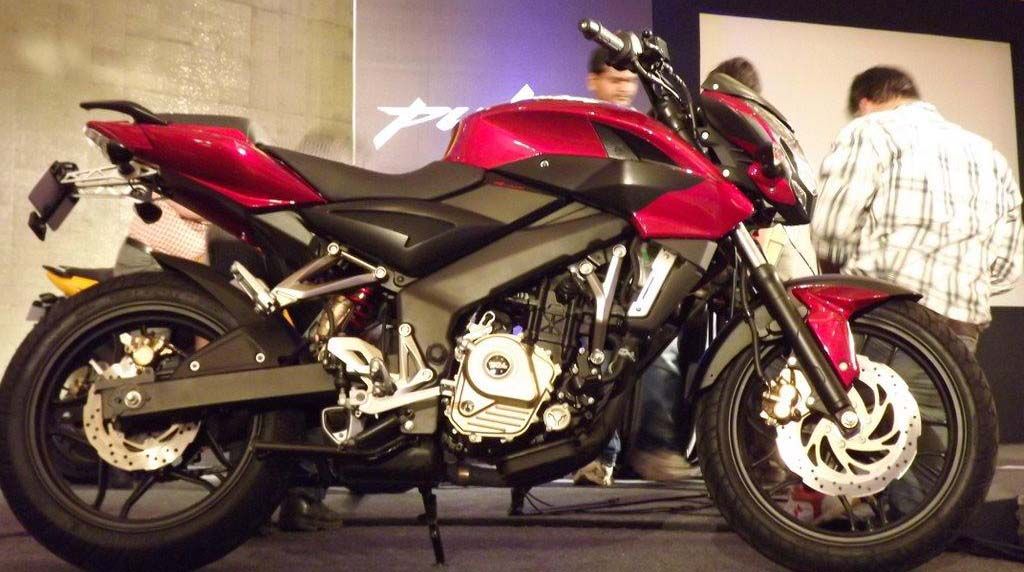
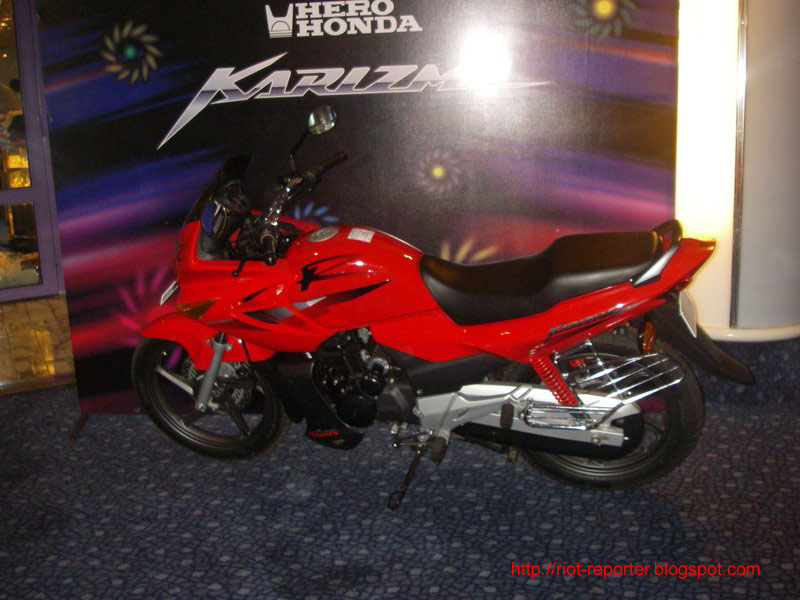
Pulsar 220cc vs Modified Karizma (K&n filter and bigger jets)
Pulsar 220cc Self-check
http://smg.photobucket.com/albums/v180/kedarg/?action=view¤t=MVI_0766.flv
Best auto news from around the world.
Go to Blogger edit html and find these sentences.Now replace these sentences with your own descriptions.
Bajaj Launches the all-new Pulsar 200NS.
Ferrari .
Go to Blogger edit html and find these sentences.Now replace these sentences with your own descriptions.


"He has to sell his car... so he has to speak like that," Bajaj shot back when reporters asked him about Tata Group Chairman Ratan Tata's remark that one of the major reasons for him to decide on the 'people's car' was the concern for safety of those travelling by two-wheelers.
Two-wheelers are sold all over the world, it has been proven that they are safe, he said, adding his company's products were safe.
Bajaj also denied that the advent of Rs one lakh car would affect the two-wheeler manufacturers.
"Ultimately it is the customers who will decide what they want," he said.
Tata had said that the Rs one lakh car would mark a paradigm shift in the way India travels and will draw customers from the two-wheeler segment as well as from the lower end of the four wheeler segment.
The small car to be powered by a 600 cc engine, which could have air conditioning option and seat four to five people, is widely considered to be a threat to the two-wheeler segment.
Tata Motors is in the process of building a plant in Singur in West Bengal for the people's car, which it hopes to roll out by next year.
The price differentials between the small car and the high end motorcycles likes of Bajaj Pulsar 200 cc, the to-be-launched Pulsar 220 cc and Hero Honda Karizma are expected to be minimal.
No division of Bajaj Auto : Rahul Bajaj
Ruling out a complete division of the Bajaj Auto empire between his two sons, Rajiv and Sanjiv, Chairman Rahul Bajaj Friday said they would continue to be part of the company even after the proposed demerger takes place.
"Both the boys will clearly continue to be in Bajaj Auto, no doubt about it," Bajaj told reporters here.
He, however, added that his younger son Sanjiv "may probably spend more time on the new demerged company or companies".
Bajaj reiterated that plan to demerge the company's financial and investments business into a separate entity was based on the intention of unlocking shareholder value by utilising surplus cash and not because of the reported "rift between the brothers".
"You cannot simply divide a company between individuals when you have so many shareholders interest to be taken into consideration," he said.
The board of Bajaj Auto is likely to take up the issue of demerger in its meeting in May or July, he added.
Sanjiv, Executive Director of BAL, however, said the demerger process was being evaluated at the moment and it would depend on what kind of impact it would have on bal.
"If the cash flows of BAL continue to be positive after the demerger, probably the board will give a go ahead. But if it is going to be negative, I don't think the board will approve of it," he said.
Sanjiv, however, added that in the past few years the company's cash flows have been positive and is likely to continue so.
Asked if the proposed demerger of Bajaj Auto would have any bearing on the company's joint-ventures with German financial firm Allianz, Rahul Bajaj replied in the negative.
"It will have no effect whatsoever on the shareholding of the joint ventures with Allianz," he said.
Bajaj Auto has joint ventures with Allianz -- Bajaj Allianz Life Insurance and Bajaj Allianz General Insurance -- in which it is the majority partner.
On the issue of BAL's 41.5 per cent holding in Bajaj Auto Finance post demerger, he said the board would decide on how and where it would be transferred.
Bajaj also said even if the board gives its nod for the demerger, the whole process was likely to take time as it would have to get regulatory and high court approvals.
BAL has about Rs 8,000 crore cash surplus and its foreign institutional investment partners have been pressing it to utilise it by hiving off the financial and investments business into separate entity.
Source:- CentralChronicle

Casey Stoner held off 22 laps of intense pressure from Valentino Rossi to take his first Moto GP win at the Qatar Grand Prix.
The 21-year-old Australian made the most of his Ducati's superior straightline speed to hold off the Italian on what was his first race for the Italian squad, triumphing by 2.838 seconds and taking a five-point lead in the championship.
Pole-man Rossi held the lead at the start, followed by Stoner and Toni Elias, but Stoner blasted by the five-time world champion as they crossed the line for the first time, giving notice of his intent to fight for victory.
Rossi's Yamaha was equal to Stoner's Ducati through the twisty section of the track, and it was there where he passed the Australian three times during the race, but was each time undone by his bike's lack of straightline speed, which was 20kph slower than his rival's.
In the end, Stoner made the decisive move on lap 19 when he powered into the lead on the approach to the first corner and then set the fastest lap of the race on the final tour to take victory.
Third was the Repsol Honda of Dani Pedrosa, who made the best of an ill-handling bike to hold off the Suzuki of John Hopkins – who was riding with his hand in bandages following a testing crash.
The pair spent the first half of the race right on the tail of Stoner and Rossi, in what was a six-bike fight for the lead with Loris Capirossi's Ducati and Marco Melandri's Gresini Honda. That battle became five-way when Capirossi binned it on lap seven.
Melandri went backwards through the first half of the race after a bright start, but recovered as his fuel load lessened to pass the Yamaha of the disappointing Colin Edwards for fifth with three laps to go.
Seventh was Chris Vermeulen on the second Suzuki, while world champion Nicky Hayden took a battling eighth on his Repsol Honda – passing Alex Barros' d'Antin Ducati with two laps to go. Shinya Nakano completed the top ten on his Konica Minolta Honda.
It was a disastrous race for Elias though, who was lay third at the first corner. After falling back through the field all afternoon, he took a trip through the gravel after being passed for ninth by Hayden and eventually finished 14th.
At least he finished though, which was more than could be said for Kawasaki's Randy de Puniet, who high-sided out on lap eight and Carlos Checa who slid off his LCR Honda next time round.

Industry watchers see this as Bajaj’s attempt to hurt the margins of Hero Honda Motors, the market leader and the largest player in the 100cc segment, just before Bajaj exits the 100cc market as scheduled in mid-2007. Hero Honda is already under pressure with analysts expecting single digit net margins for the first time in history in the Jan-March quarter. If it responds to the Platina price cut, margins could get even thinner.
In an e-mail to its dealers, Bajaj Auto’s vice president, marketing and sales (two-wheeler), S Sridhar, wrote, “Platina would drive huge growth for us and this would be experienced in March, April and May '07. We are fully prepared for the post-Holi marriage season gameplan.”
The move comes at a time when Bajaj Auto’s sales showed negative growth. In February, Bajaj Auto sold 1,74,220 units, down 3% as against 1,79,880 units in the same month last year.
Platina’s new price, Rs 31,714 (ex-showroom in Uttar Pradesh), would break the 100cc segment's price barrier set by Hero Honda's cheapest model CD Dawn (Rs 31,900). Of late, the sales of the newly-refurbished CD Dawn have taken off, spurring Hero Honda's overall sales and helping it widen the lead over Bajaj Auto. During February, the gap between Hero Honda and Bajaj once again widened to 1.06 lakh units, up from 37,883 units in September last year.
According to auto analysts, Hero Honda's current product mix, including the renewed CD Deluxe, CBZ X-treme, Passion Plus (limited edition) among four others has helped the company thwart Bajaj's gameplan to overtake the number one bike manufacturer so far. Bajaj also intends to price its 125cc-plus bikes in the same range as that of the 100cc bikes in the market.
“Our move to exit 100cc segment and making new bikes with high value proposition for customers are bound to move not only Bajaj customers but the whole of 100cc customers in favour of the new bikes. Platina, which sells around 60,000 units a month, accounts for nearly 10% of the 7 million units domestic bike market,” Sridhar said in his mail, adding that the launch of new bikes will take four to five months from now.
Source:- FinancialExpress
"With increasingly strong sales of Discover (125cc) and Pulsar DTS-i (150-180cc) platform products, only 45 percent of Bajaj motorcycle sales come from the relatively lower margin 100cc segment," Managing Director Rajiv Bajaj said.
Product design and specifications for the new platform that will be launched in the second quarter of the fiscal year to March 2008 have been finalised and trials have been scheduled for the April-June quarter, he said in a statement.
Bajaj will also commence production at a new plant in Uttarakhand in April, and plans to ramp up its output to 1 million units during the course of the fiscal year.
The new launches, along with robust sales of motorised three-wheelers and more exports should "stabilise, if not enhance profitability" in the fiscal year to March 2008, Bajaj said.
Shares in Bajaj were unchanged at 2,763 rupees in a firm Mumbai market.
The Bajaj Platina 100cc bike competes with the Hero Honda CD series and TVS Motor's Star City.
Hero Honda has said it is expanding its offering in the entry-level, which contributes about 40 percent of its revenue.
Hero Honda and TVS Motor reported worse-than-expected quarterly earnings on high raw-material costs and fierce competition that prevents bike makers from increasing prices and forces heavy advertising and promotion expenses.
Bajaj said sales of motorcycles rose 12 percent in January from a year earlier to 195,560 units. Vehicle sales, including three-wheelers, gained 13 percent on the year to 229,583 units.
Bajaj, overtaken by Hero Honda in 2002, has vowed to reclaim leadership in the world's second-biggest motorbike market.
It expects to sell about 2.85 million vehicles in the fiscal year to March 2007 and is investing 15 billion rupees over three years to take its overall capacity to 5.1 million units by 2009.
Source:- in.today.reuters


ENGINE & TRANSMISSION:CHASSIS & BODY
- Type Four stroke, Natural air cooled/oil cooled.
- No. of cylinders One.
- Bore 67 mm Stroke 56.4 mm
- Engine displacement 198.8 cc
- Compression ratio 9.5 *+* 0.5 : 1
- Idling Speed 1400 *+*100 rpm.
- Maximum net power 18 Ps (Bajaj figures convert directly to bhp)/13.25Kw
- Maximum net torque 17.17 Nm/1.75kg
- Ignition system Digital CDI
- Ignition Timing 10° 1400 rpm 28° 3500 rpm
- Fuel Unleaded petrol. Carburettor UCAL MIKUNI BS29
- Spark Plug : 2Nos. Champion RG4HC (Resistive)
- Spark plug gap0.6 to 0.8 mm
- Lubrication Wet sump, Forced
- Starting Electric Start only
- Clutch Wet, multidisc type.
- Transmission 5 speed constant mesh.
- Primary reduction 3.47 : 1 (66/19)
- Gear Ratios 1st 26.04 : 1 (36/13) 2nd 17.67 : 1 (32/17) 3rd 12.97 : 1 (29/21) 4th 10.15: 1
- (26/24) 5th 8.65 : 1 (24/26)
- Final Drive Ratio 2.71 : 1 (38/14)
ELECTRICALS
- Frame type Double cradle type.
- Suspension: Front Telescopic (Stroke - 130 mm.)
- Rear Trailing arm with coaxial gas assisted hydraulic shock absorbers and coil springs.
- Brakes:
- Tyres: 90x90 X 17, 49P, Tubeless
- Tyre pressure:
- Rims : Front : 2.50 x 17
- Fuel tank capacity15 litres.
- Controls :* Steering Handle bar Accelerator Twist grip type on right hand side of handle bar. Gears Left foot pedal operated Clutch Lever operated on left side of handle bar. Choke Push-Pull knob on carburettor. Brakes Front :Lever operated on right side of handle bar. Rear : Pedal operated by right foot.
- Length :2035 mm.
- Width : 750 mm
- Height :1165 mm.
- Wheel base :1350 mm.
- Turning circle radius : 2500 mm.
- Ground Clearance:165mm.
- Vehicle kerb weight: 145 Kg
- Max. total weight : 280 Kg.
PERFORMANCE
- System 12 Volts (D.C.)
- Battery 12V 9Ah MF type
- Head lamp 35/35 W Pilot lamp( 2 nos ,5 W each)
- Tail/stop lamp LED/LED
- Turn signal lamp :10 W
- Turn signal pilot lamp : LED
- Side stand indicator lamp : LED
- Hi beam indicator lamp : LED
- Neutral indicator lamp : LED
- Speedometer lamp : LCD Display
- Rear No. plate Lamp : 5 W
- Horn :12 V DC
The above specs are taken from Yahoo Bajaj Pulsar Group.
- Maximum speed :130 km/h with single rider (68 kg) (claimed)
- Price :- 63,019 (ex-showroom) Pune
Hands-On Report:-
The new Pulsar has a very sporty riding position. The handlebar is lowered a bit and foot pegs are also kicked back for sportier riding position. The bike has great acceleration and the acceleration is awesome. We found the vibes to be lower than Pulsar 180 kinda Unicornish. The new split seats (from Pulsar 220) look great and are comfortable.
The switchgear quality is top notch and paint quality is really good and seems like it will last long. The Headlight bulb and the pilot lamps (wolf eys) are white. They are Halonix 35/35W bulb i expected brighter Headlamps. Sadly u cannot put bigger bulbs without any mods as The headlight and pilot lamps are not on battery. They get their power from the alternator.
The bike is loaded with MRF Zapper Tubeless tires 90/90 at front 120/80 at back. The tubeless zappers have great grip. There is a Bigger 260mm disk upfront and a 130mm drum brake on rear. There is no chain cover. The bike uses O`ring sealed chain which promise to last longer than the chain used in other indian bikes.
Those who like Kicking better play Football, there is no Kick starter on this new Pulsar. The only way to start the bike is through Electric start and if the battery dies, u can always push start the bike. There is no harm push-starting a Carburated bike. The engine roars more and exhaust note is better. Company claims the top-whack to be 130km/hr but that can be known only after a full road-test. Watch out for this space and we will be bringing a full road-test soon.
Pics are taken by www.xBhp.com member Xionite
| Luxury car manufacturer DaimlerChrysler�s Indian subsidiary Mercedes is all set to introduce the new C-Class in the domestic market by early 2008. |
| Recently at its unveiling, the new car attracted the attention of auto enthusiasts worldwide for its rather unorthodox design and style cues. |
| Sanjiv Sahajwala, director, sales and marketing, DaimlerChrysler India, said, �We are planning to launch the new C-Class, which is currently under production in the overseas market, in India by early next year. We would have to set up its basic equipment in our manufacturing units in the country in line with the new car. This will be done in the next 8-9 months.� |
| The company is planning to halt production of the current model by October this year. |
| DaimlerChrysler has not yet decided on the vehicle�s pricing, but experts said it might be priced on the lines of the outgoing model. |
Not only has Maruti fitted the diesel Swift with a 1.3 litre DDiS (common rail diesel technology) engine which is Euro IV compliant, but the company has also managed to price the product aggressively “under Rs 5 lakh” psychological barrier. The company claims that this engine is the smallest 4-cylinder diesel engine for passenger cars anywhere in the world. Maruti is manufacturing the new engine at its Manesar plant, which has initial installed capacity of one lakh units per year but will be scaled up to 3 lakh units with a total investment of Rs 2,500 crore.
There are no other diesel hatchbacks now in India except the Tata Indica; they mostly exist in the larger, sedan cars with prices significantly higher than the Swift diesel variant. So what Swift diesel could do is bridge the gap between petrol hatchbacks and expensive sedans for customers wanting to buy a low-priced diesel car.
Says managing director Jagdish Khattar: “This car is the most fuel- efficient diesel car in India.”
Maruti claims the car can give 21 km per litre on highways and 14-15 km per litre in normal city-driving conditions. The base model called Ldi is priced at Rs 4.68 lakh while the Vdi comes for Rs 4.96 lakh (both prices ex-showroom Delhi).
About the development of this engine, Khattar said that over the past few months it has been localised to 70% but more work needs to be done.
But with Maruti getting aggressive in diesel, is competition sitting pretty? Hyundai is believed to be putting together diesel engines for the Getz and the Santro. The recently launched Chevrolet U-VA may come with a diesel engine and the brand new Dicor engine for the Tata Indica may also become a reality soon. What remains to be seen is whether the customer laps up a lower-priced diesel variant.
Typically, the Indian perception of diesel cars has been vehicles that make noise and require more maintenance than the petrol counterparts. The common rail technology of Swift could well change this perception. Then, diesel is at least 30% more fuel efficient than petrol and this price equation may also lead to a surge in diesel car buyers in the coming months.
Khattar dares Tata in Singur, too
Maruti Udyog’s managing director Jagdish Khattar on Wednesday asked Tata Group chairman Ratan Tata to clarify his allegation that a competitor was behind the Singur furore. “I don’t know which competitor he (Tata) is talking about. Since he has the knowledge, he should tell it.” Khattar added: “We believe in healthy competition.” Last month, Tata alleged that he suspected competitors to be behind the controversy at Singur in West Bengal, where the Tatas are setting up a manufacturing
plant for their Rs 1 lakh car.
The world over, vehicle makers are looking for ways to use hydrogen fuel in new products, but this project seeks to develop the CNG-hydrogen mixture (called Hithane) for use in the existing on-road fleet of vehicles with minimum modifications in the engine and engine components.
The participating companies are providing seven different types of vehicles for this Rs 5 crore project, which is being done in partnership with the ministry of new and renewable energy. In fact, SIAM and the ministry are expected to sign a memorandum for the purpose soon.
During the course of the project, all vehicles - three light commercial vehicles (LCVs), two three-wheelers, a sports utility vehicle (SUV) and a passenger car - will be first tested on various blends of Hithane. Blends containing between 10-30% of hydrogen will be tested to get to the optimum blend that reduces emissions and achieves the desired fuel supply sustainability. Thereafter, this blend will be used to modify vehicle engines for optimum performance with the new fuel.
The hydrogen needed for this project will be sourced from Indian Oil and a hydrogen station is expected to come up at the Central Government Officers’ Complex in Delhi. Hithane not only reduces dependence on foreign oil, but also cuts down on NOX (nitrous oxide) emissions and helps achieve better fuel efficiency.
In a hydrogen engine, electricity generated from solar power is used to split water into hydrogen and oxygen. Oxygen is released into the atmosphere, while hydrogen is liquefied and stored at a very low temperature (-253 °C). During internal combustion, the hydrogen combines with oxygen and the resulting energy powers the vehicle, while the hydrogen is returned to the environment as water.
However, several issues have to be addressed before viable hydrogen engines can be developed indigenously. Explains Arun Jaura, senior vice-president (R&D and Product Development) at M&M: “Use of hydrogen in vehicles poses several challenges such as its availability, distribution, on-board storage and safety. The SIAM project is the first step towards looking for a viable use of hydrogen in automobiles in the Indian context.” M&M has already made a beginning with hydrogen - by showcasing a concept vehicle called HY-Alpha Champion - a sub-one tonne three-wheeler which runs on compressed hydrogen gas.
Source:- DNAIndia
This would be their latest offering for the Indian consumer and they hope to perform well by selling good numbers of this car in India. Ian Robertson CEO, Rolls-Royce spoke about their Indian ambitions: “I think it’ll have a very positive reception. Many of the older convertibles, dating right back to the ’20s and ’30s are in India today. So, we anticipate this will have a strong hold in our sales, going forward.”
The company in order to expand their availability would be opening its second Indian outlet in New Delhi. Their first dealership was opened in Mumbai in 2005. Rolls Royce hopes to attract more millionaires to their vehicles.
Robertson added: “I think there are still maharajahs who are buying these cars but we are also seeing the introduction of the car to many new entrepreneurs - people who have started up their businesses, people who have seen a great deal of success in just a few years. And from that perspective, right across Asia, we see a much younger profile in our overall sales now.”
Source:- AutoIndia